
The New Ecommerce Growth Playbook For 2026

.avif)
.avif)
.avif)
Facebook advertising created a 10-year window where growing an ecommerce brand to $50M was almost... easy. With a decent product, a basic funnel, and a few ads, anyone could launch a brand and drive a profit.
But that era is over.
- CPMs are climbing
- CAC is increasing across every channel
- Winning ads expire faster
- And attribution has become more complex
That doesn't mean ecommerce isn't still in its heyday. We covered five recent DTC marketing success stories here, but the highlights are:
- MUD\WTR built a $400M brand in less than five years
- We grew Purdy & Figg from £452K to £50M in three years
- Obvi grew from $0 to $40M brand in just three years
- Day's Brewing grew online sales by 700% in two year
- We 10x'd Wildbird's revenue at 17.5% net profit in two years
The wins are still coming, but the ecommerce growth playbook has changed.
The standards for efficiency, creative volume, and marketing expertise are much higher than they used to be.
In this guide, we'll outline the ecommerce growth strategies we are using right now to help DTC brands between $2M to $50M break through plateaus and reach the next phase of growth. Our combination of financial forecasting, scalable creative systems, and efficient growth methods is critical for any brand wanting to continue growing in the new era of ecommerce.
1. Start With Your P&L
The #1 shift for ecommerce in 2026 is the transition from marketing-led growth to finance-led growth.
In the past, brands started with gut calls or lofty ambitions, "We want to triple last year's growth", and then tried to force marketing spend to hit those arbitrary targets.
We call this "Black Magic Forecasting", and it's the financial equivalent of building a house without a blueprint. You wouldn't pour a foundation without knowing if the budget covers the roof, yet brands launch campaigns daily without knowing if their unit economics are actually viable.
Top-performing brands don’t guess. They know their marketing goals inside out and reverse engineer their marketing goals from the bottom up.
At Kynship, we treat the financial forecast not as a static spreadsheet, but as the operating system for your entire growth strategy. It acts as the single source of truth across marketing, finance, and operations, reconciling monthly to tell us exactly what we can afford to pay for a customer to ensure sustainable growth.
Here is how we engineer a forecast that turns your P&L into a direct line to execution:
A. The Inputs: Beyond "New vs. Returning"
To build a forecast that gives you confidence rather than guesses, we need more than just revenue targets. We begin by analyzing:
- SKU-Level Economics: Not all products are equal. A high-margin hero product allows for a different CAC target than a low-margin bundle.
- Three-Cohort Analysis: Most brands track "New" vs. "Returning." We go deeper, splitting customers into New, Recently Acquired (last 180 days), and Active Non-Recent. This granularity allows us to predict churn and repeat rates with high precision.
- Profit Requirements: If you want to sell for $100M in three years, what level of monthly profitability is required today to make that a mathematical reality?
We also need to understand the business model's potential. Is this a business where subscription products make sense, and we can aim for breakeven (or less) for new customer acquisition? Or is first order profitability where we need to focus?
B. The Outputs: Profit-Aligned Execution
Once we have your historical data and unit economics, the forecast dictates the strategy. Instead of shooting in the dark, you have a clear idea of "If we do X, Y should happen."
This approach provides the brand with:
- Exact CAC Ceilings: We calculate specific 7-day click targets that account for your delayed attribution lift (the revenue that comes in between Day 7 and Day 28).
- Contribution Margin Goals: We move away from blanket ROAS targets and focus on the contribution margin required per SKU.
- Clear Payback Limits: We know exactly how aggressive we can be on acquisition while keeping cash flow healthy.
The Bottom Line
A proper forecast removes the emotion from decision-making. It validates that if we execute on specific financial targets, the business will achieve its profit goals. It gives you the confidence to scale, not guess.
For more on ecommerce forecasting, checkout our Youtube series:
2. Build & Scale Your Creative Pipeline
Creative pipeline is where we find the second big shift from the old ecommerce growth playbook.
DTC advertising success today is driven more by creative volume than creative budget.
In the previous era of ecommerce, a single creative could carry massive ad budgets for years. While there was still the risk of producing a flop, the staying power of high-performing creative justified allocating massive budgets to professionally-produced shoots.
In the new era of ecommerce, this is a bad strategy for two main reasons:
- Creative fatigue happens faster than ever. Very few ads will last long enough to justify a massive upfront expenditure.
- Cost-effective IGC, UGC, and CGC videos are frequently among a brands top-performing creative.
What this means is that a low-budget system producing hundreds of cheaply-made creative each month is nearly always going to outperform even a high-budget system focused on releasing a handful of polished creative each month.
A. The Three Pillars of Modern Creative
Our approach at Kynship revolves around the following three pillars.
- Creative Volume: Creative fatigue happens faster than ever. An ad that works today might burn out in two weeks. The only way to maintain performance is constant iteration. You need a pipeline that produces enough volume to test angles, hooks, and formats while constantly producing new winners.
- Creative Variety: True variety means testing entirely different formats: founder-led content alongside UGC, memes alongside educational demos. Variety hedges against algorithm changes. When one format stops working, three others are already live.
- Creative Authenticity: Polished, overproduced ads get scrolled past. "Human-forward" content shot on an iPhone, with raw voiceovers and casual framing frequently outperforms studio-quality production because it looks native to the platforms its shown on.
B. The Execution: Three Distinct Pipelines
You cannot achieve this level of volume and variety relying solely on an in-house videographer. We build three specific pipelines to drive scalable creative for our clients.
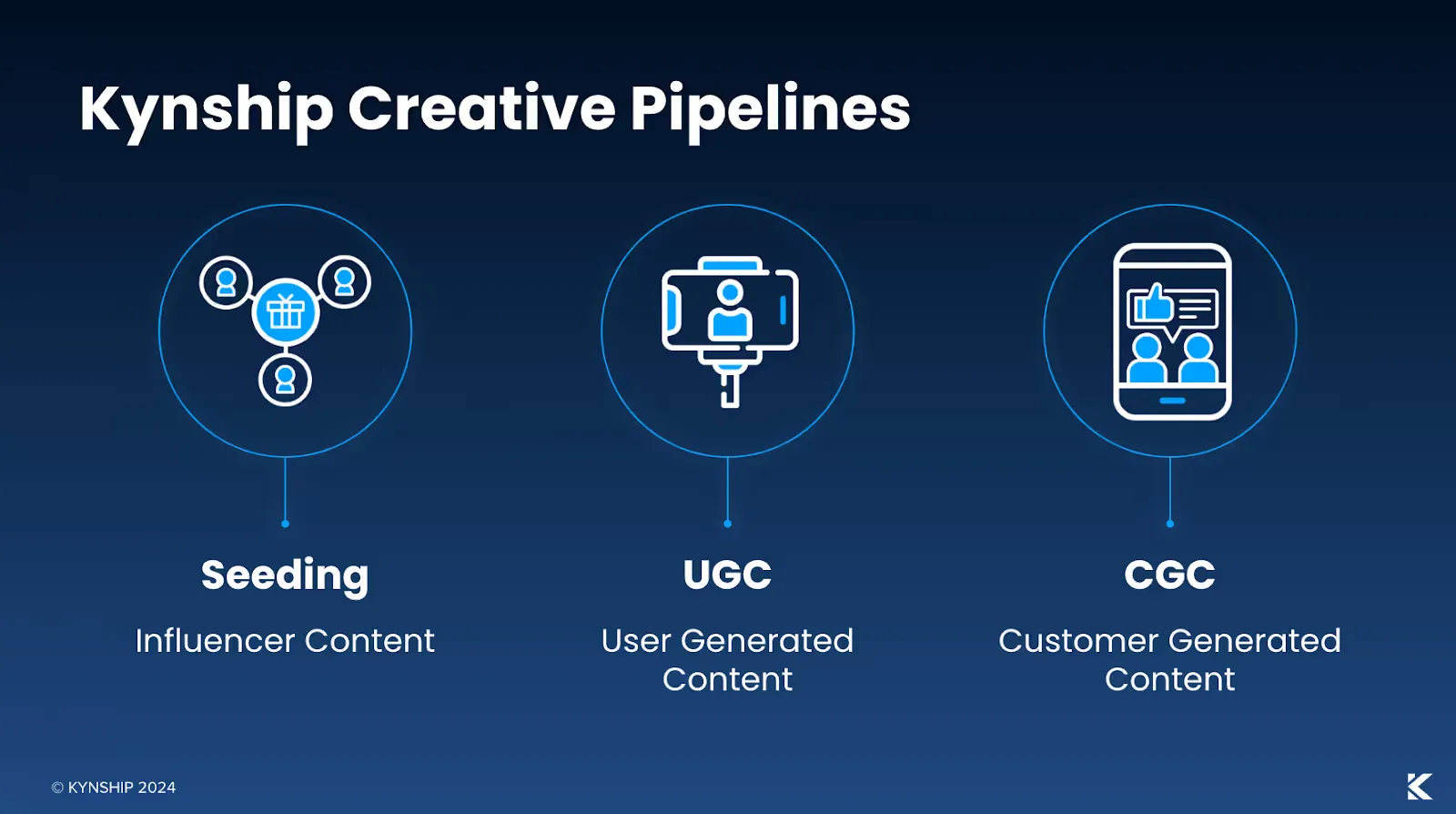
1. Influencer Seeding (IGC)
This is our primary engine for authentic content. We target 500 micro-influencers who fit the brand persona and send them products as a gift, no strings attached.
For every 500 creators we contact, ~100 respond (20%), and ~30 will voluntarily post content. This results in ~30 unique, authentic creative assets for the price of COGS x 100 units.
Once seeded creators post, we request usage rights to run these organic posts as Whitelisted Ads (Spark Ads), which often results in significantly lowers CPMs due to higher social trust.
2. User Generated Content (UGC)
This is where we fill in the gaps. We hire seasoned creators to execute specific briefs to fill our "Creative Batching" needs.
We provide specific hooks, talking points, and formats, and this modular approach lets us mix and match hooks and bodies to extract maximum value. One creator shoot can yield 36 to 72 unique asset variations.
3. Customer Generated Content (CGC)
Your best copywriters are your customers. These are your most authentic, least professional assets, and they are often your highest converters.
Identify your top 50 highest LTV customers (2+ purchases) and send a tailored email offering a free product or store credit (e.g., $100) in exchange for a simple 30-second video testimonial.
You will typically convert 10-15% of these requests, an unlike influencers, customers speak with raw honesty that creates unbeatable social proof.
The Bottom Line
Speed x Volume x Variety = Winning Ad Campaigns
Instead of hand-picking the one creative you think will work, feed the algorithm a massive volume of diverse data points and let the machine determine the winner.
For more on scaling creative, read our guide to Building A Creative Flywheel.
3. Change Your Meta Strategy To Cost Controls
You have a financial map telling you what you can afford. You have a creative engine pumping out assets. Now, you need an environment where that creative can actually thrive without destroying your margins.
When Facebook ads were easy, the best media buyers differentiated themselves by finding ways to "play" the algorithm better than other media buyers. They developed an entire playbook of micro-hacks and account tweaks that performed best.
But frankly, none of those account details and scaling hacks are relevant anymore.
The Meta algorithm of today is far better at finding buyers for your brand than any human media buyer.
That includes you. That includes me. That includes anyone you follow on X or LinkedIn.
If you want to spend efficiently, you really only need to do one thing, and you already did it back during the P&L step: figure out how much you can afford to spend per customer.
Cost controls let Meta spend as much as it can, provided it can hit your target CAC.
A lot of folks think that cost controls limit spending, but they actually do the opposite. We had one client's spend jump from $4k to $400k in ONE day as Meta found a hot pocket of buyers during the holiday season. This COULD NOT have happened with manual bidding.
With the cost controls approach that we use at Kynship, we are able to keep all our evergreen ads running long-term, because Meta automatically adjusts spend to prioritize the winners, WHILE maximizing spend, WITHOUT sacrificing efficiency.
Here's how it works.
A. Give the Algorithm a "Hard Restraint"
With Cost Controls, you set a fixed CAC tied to your financial forecast.
This changes the dynamic: Instead of telling Meta "Spend this budget no matter what," you tell it, "Only spend money if you can hit my target." This prevents waste, because the algorithm stops spending on low-quality auctions just to fill a daily quota, and it uncaps efficient spending, because the algorithm doesn't stop driving traffic through hyper efficient periods due to a budget cap.
B. The "50x Rule" for Budgets
If you are using Cost Controls, your daily budget is no longer a spending target. It's simply a guardrail.
- The Formula: Target CPA x 50 = Daily Budget.
- Example: If your target CPA is $50, your campaign budget should be $2,500/day ($50 x 50).
The goal is to get out of the learning phase in 24 hours. You typically won't spend the full amount, but the high ceiling gives the algorithm the room it needs to find pockets of efficiency.
C. How to Scale (The 15% Rule)
Once your campaigns are live, you need a disciplined system for scaling. Don't just double budgets overnight.
- Vertical Scaling: If your campaigns are hitting targets and spending 50% of your daily budget, increase the budget by 15% increments. This controlled scaling ensures efficiency holds steady as volume increases.
- aMER Adjustments: If your overall aMER (Acquisition Marketing Efficiency Ratio) is too low, tighten your cost controls by $5. If aMER is above target, loosen controls by $5 to encourage more spend. Repeat this until you hit the sweet spot.
D. Manipulate CPA with Creative, Not Bids
If your ads aren't spending or your CPA is too high, do not try to "hack" the bid.
- Creative-Driven CPA: The #1 lever to lower costs is creative. If a campaign stalls, we test fresh angles and hooks to lift conversion rates rather than messing with technical settings.
- Account Spend Threshold: We have a spend threshold on the entire account that will shut down all ad spend and protect the account if a bug occurs.
The Bottom Line
If you want to scale from $5M to $50M without collapsing your margins, you must stop guessing.
- Forecast your exact affordable CAC.
- Build a creative pipeline that refreshes assets 4x per month.
- Deploy via Cost Controls to lock in your unit economics.
This system ensures you hold CAC steady across higher spends and keep your growth aligned with actual profitability.
For more on cost controls, checkout this episode from our podcast:
4. Focus On Meta & Google Through $50M
One of the biggest pitfalls for new founders is shiny object syndrome. It's very easy to lose focus on the 20% of actions that drive 80% of results, and nothing kills a business faster than an easily-distracted founder.
Nowhere is this more true than the discussion around multi-channel marketing for ecommerce growth. It's so easy to start chasing YouTube, TikTok, podcasting, etc. before you've built a predictable, scalable growth engine on Meta and Google, and pursuing multi-channel at this stage is far more likely to hurt you than help you.
The fear is often that you need multi-channel to sustain growth, so let us put your mind at ease.
If you've crossed $5M annual revenue with Meta ads, Meta & Google can take you to $100M without any additional marketing channels.
But the reality is Meta and Google still drive 80–90% of all DTC volume between $5M and $100M, and we don't recommend you even begin thinking about multi-channel expansion until you’ve reached $50M.
Meta checks all the boxes for DTC:
- It has consolidated campaign structures that improve signal density and deliver more stable, efficient optimization at scale
- Its broad targeting means Meta’s algorithm can find the right buyers without restrictive manual segmentation
- Consistent bid strategies reduce volatility and let machine learning optimize toward efficiency
When you add Google into the mix, it helps capture demand leaking from Meta. It also helps smoothen CAC volatility because search demand is steadier than social. Protecting branded terms also prevents competitors from capturing customers that your brand search generated.
Amazon is sort of the exception here. We typically recommend that our clients list on Amazon (with some notable exceptions, ex. jewlery brands), but we don't recommend investing in Amazon ads. Our clients regularly see a halo impact on Amazon sales as a side-result of Meta spend. One client increased Amazon sales from from $9k/m to $600k/m in a single year without increasing their Amazon budget.
The way we like to think about it is that once you cross the $50M threshold, you "earn the right" to begin broadening your plans to other channels, like:
- TikTok ads: TikTok can be your top-of-the-funnel accelerator—shaping cultural relevance and producing rapid creative learnings that feed both TikTok and Meta performance.
- YouTube: YouTube acts as a hybrid of reach and intent, using short-form for awareness and YouTube discovery/PMAX inventory to convert warm demand efficiently
- Affiliate networks: Affiliate programs diversify revenue streams by incentivizing creators, publishers, and customers to drive incremental conversions without heavy fixed spend.
- Retail partnerships: Physical expansion into stores like Target, Walmart, Whole Foods, and Sephora can expand your brand’s distribution significantly and increase credibility.
- CTV/Streaming: A great option for reach-based paid media. You achieve large-scale reach and storytelling impact, building brand memory that lifts conversion performance across lower-funnel channels.
Remember to use your unit economics as a gatekeeper. Don’t introduce a new channel until you can model its CAC, retention, and payback period against your current margins.
And similar to Meta and Google, create repeatable creative, measurement, and spend frameworks for each new channel so they scale predictably.
The Bottom Line
Focus only on mastering your Meta and Google ad engine until your brand reaches $50M. Once you reach the $50–$100M bracket, start thinking about multi-channel expansion without losing sight of your forecast and economic flywheel. And aim for expanding into multi-channel at the $100M mark.
5. Test Offers Like You Test Creative
When we talk about product/market fit, we really aren't talking about your product. We're talking about your offers. An offer is the exact package of products, discounts, and pricing that end up in front of the consumer. The creative may drive the click, but it's the offer that drives the sale.
And yet most brands treat offers as a "set it and forget it" strategy. They have their full retail offer, their permanent-discount offer, and then their lazy "10% off” email popup.
Please don't make that same mistake.
You should test your offers just like you test creative.
At Kynship, we look to max out the ad account with the available space from an ad capacity standpoint. If we aren't filling up that entire capacity with creative wins, we integrate new offers to fill the rest of the real estate.
Here's how we approach offer testing.
A. The 4 Factors of Offer Engineering
Before you launch a "Buy One Get One," you need to audit your business. Offer creation isn't a guessing game; it’s a math equation based on four inputs:
- Cost of Delivery (Not just COGS): This is your product cost plus shipping and fulfillment. Adding a second unit to an order often doesn't double your shipping cost, creating added margin that allows you to be more aggressive.
- Basket Predictability: Do customers always buy the same "Hero" SKU (High Predictability), or do they buy a random assortment of items (High Permutations)?
- LTV (Lifetime Value): If you have high LTV, you can afford a "loss leader" offer upfront. If you have low LTV, the offer must be first-order profitable.
- Existing Behaviors: What are customers already doing organically? If 13% of people are already buying two units, build an offer that amplifies that specific behavior.
B. Match The Offer to the Business Model
Here is how we apply those four factors to build specific offers for different types of brands:
Scenario 1: High Predictability + High LTV = The Subscription Play
For brands with high cart predictability and high Lifetime Value (LTV), the goal is often to amplify recurring revenue.
One of our clients had a "hero" product drove 74% of sales, so we introduced a "Hero Product Subscription + Free Gift" offer. Because the retention data was strong, the math proved that the customer's LTV justified the upfront cost of the free gift.
Even better, this strategy served a dual purpose of locking-in subscriptions while introducing customers to a second product category, further increasing retention and long-term value.
Scenario 2: Low Predictability + Low LTV = The Threshold Play
On the opposite end of the spectrum, brands with thousands of SKUs and low LTV face a "permutation" problem: customers buy random assortments, making specific bundles hard to predict.
For a jewelry brand in this position, we implemented a "Threshold Play" where the offer was simply: "Spend $100, Get a Free Gift." Since we couldn't rely on long-term backend revenue, this strategy forced a higher spend upfront, artificially inflating the Average Order Value (AOV) to ensure the transaction was first-order profitable enough to cover the acquisition cost.
Scenario 3: Slow Season = The Appetizer Play
A lot of DTC brands experienced massive seasonality in their sales, and we've learned to take a page from restaurants in using offers to boost sales during a slow season. If you've ever studied restaurant marketing, you've probably noticed that the most aggressive offers, discounts, giveaways, and happy hours usually revolved around appetizer items on the menu.
Why? Because appetizers are typically high-margin dishes made up of low-cost ingredients like potatoes, breads, and cheese. Restaurants can offer a free appetizer "worth $20" for about $2 in COGS, making these types of offers perfect for capturing attention and getting people in the door.
When sock brand Southern Scholar was facing a historically slow summer, we proposed offering an aggressive "Buy 4, Get 4 Free" offer, and because the product had such a low COGS, this offer allowed them to unlock scale during a dead month, while still bumping their overall profitability by 10 points, even with the lower margins.
C. Test on an Island
A common fear is that running aggressive offers will "dilute the brand" or confuse customers. To avoid this, test on an island. Do not plaster these offers on your homepage. Run them on siloed landing pages where the only traffic source is the specific ad campaign.
Break these offers at the Campaign Level. Different offers lead to different financial outcomes (AOVs, margins, LTVs) and therefore require different Cost Controls and targets. You cannot optimize a "Buy 4 Get 4" offer against the same target as a "Standard Subscription" offer.
The Bottom Line
Test your offers like you test creative. The sale that people sign up for is a combination of multiple components, any of which could be the bottleneck on sales. Sometimes a price change can have a huge impact. Sometimes bundling can unlock growth. Sometimes threshold pricing can push AOV into a range that uncaps spend.
You don't know until you test.
For more on offer testing, check out this episode from our podcast:
6. Use Retention & LTV as Your Revenue Multiplier
Retention is what determines how aggressive you can be everywhere else. It sets the ceiling on your CAC, the speed of your payback, and the confidence with which you can scale.
But most brands think about retention wrong.
Retention is less about tactics and more about math.
Most retention advice revolves around this idea that retention and LTV are persuasion issues, and thus, a marketing problem to be solved.
But no amount of email flows, automations, loyalty programs, SMS sequences, birthday points, VIP tiers, or referral bonuses are going to turn a low-frequency product into a high-frequency one.
You can’t out-market your product’s natural consumption cycle. If customers only need your product twice a year, no Klaviyo wizardry will get them to buy monthly. That’s why brands running massive retention stacks still sit at a 15–25% year-one repeat rate.
Cross-selling follows the same pattern. Customers bought Product A because they wanted Product A. Moving them into Product B, especially when it's in a different category, entails heavy friction and will rarely be predictable.
The real problem isn’t a lack of tactics. It’s misplaced expectations about what actually drives retention.
At Kynship, we treat LTV as a financial input, not a marketing outcome. We don’t ask, “How do we increase LTV?” We ask, “Given this product and this customer behavior, what LTV is realistic, and how do we design the business to fully capture it?”
Here's how we answer these questions in trying to maximize LTV.
A. Diagnose Your True Retention Ceiling
Before you build a single flow, you need to understand three things:
- Consumption Cycle: How often does a customer realistically need to buy again? Daily, monthly, quarterly, annually? This defines the maximum possible frequency, no matter how good your marketing is.
- SKU Stickiness: Do customers reorder the same product, or do they churn after the hero SKU? Brands with strong second and third purchase attachment behave very differently than one-hit-wonder products.
- Cohort Decay: How quickly do customers fall off after their first purchase? We look at repurchase rates across the same three cohorts used in forecasting, New, Recently Acquired, and Active Non-Recent, to identify where value is leaking.
This diagnostic tells us whether LTV should be driven by frequency, expansion, subscriptions, or simply improving first-order profitability.
B. The Only 4 Retention Levers That Move the Needle
Only a handful of levers truly influence LTV, and they’re almost always tied to customer behavior and experience, not complex automations.
1. Send More Emails
Not better emails. Not more segmented emails. Just… more. If you send two per week, try four. If you send four, try six or seven.
Yes, unsubscribes go up. But revenue goes up more. Your real buyers want to hear from you more often, and unsubscribers were unlikely to purchase anyway.
The only caveat: you need enough product breadth or content variety to sustain the volume.
2. Create Moments Through Product Releases
Retention doesn’t come from evergreen flows. It comes from moments.
Drops, launches, collabs, seasonal collections, anything that gives past customers a fresh reason to reengage.
A consistent release cadence creates anticipation, reactivates lapsed customers, and often boosts sales of existing best sellers, not just the new item.
3. Nail Operational Excellence
No retention flow can compensate for a bad delivery experience.
- Fast shipping
- Clean packaging
- Clear instructions
- Easy reordering
- Zero friction
This is the invisible engine behind strong retention. It isn’t glamorous, but it meaningfully increases the likelihood that already-satisfied customers come back.
4. Use Subscription Where It Naturally Fits
Subscription is retention on autopilot... if the product supports it. It's great for consumables: supplements, skincare, pet food, coffee, meal kits. It's terrible for infrequent purchases: apparel, furniture, gadgets.
Subscription isn't a growth hack. It’s simply the easiest path to reorder when the product has predictable consumption.
C. How Retention Changes Your Growth Math
Higher LTV does a lot more than increase backend revenue. It fundamentally changes how you acquire customers.
With strong retention:
- You can raise CAC ceilings without hurting profitability
- You can scale faster without cash flow stress
- You can win auctions competitors are forced to exit
- You reduce reliance on constant creative hero ads
This is why we say retention is a multiplier, not a channel. Every improvement compounds across Meta, Google, creative testing, and offer strategy.
The Bottom Line
Acquisition gets you customers. Retention determines how valuable they are.
Brands that win in the next era of ecommerce don’t chase retention tactics blindly. They understand their consumption cycle, design offers and products around real behavior, and use LTV to unlock more aggressive, confident growth on the front end.
For more on retention and LTV, check out our deep dive on this topic in our podcast series.
7. Build a Memorable Brand (That Lowers CAC)
A lot of founders hear “build a brand” and think it means a new logo, prettier packaging, or paying an agency to write a manifesto.
That’s not what we mean.
A brand is a set of associations in a customer’s mind that makes them trust you faster, choose you faster, and come back without being bribed.
In a world where CPMs rise and attribution gets messier every year, brand is one of the only levers that improves performance even when the platform mechanics get worse.
Brand does three practical things for a DTC business:
- It increases conversion rate, because people already believe the claim before they hit your site.
- It increases repeat purchases, because the product becomes part of a routine or identity.
- It lowers CAC, because demand starts to show up outside the ad account.
We see the evidence of this in branded search. The biggest brands can outspend everyone, because they have hundreds of thousands of customers looking them up by name when they are reading to purchase ($0 cost), NOT because their retargeting ads are better than the competition.
Here are some hyper-tangible ways to build a memorable brand.
A. Pick One Idea to Own
Most brands are trying to be “premium,” “clean,” “sustainable,” “high quality,” and “better for you” all at once.
That is not positioning. That is a list of table stakes.
A strong brand owns one clear idea that customers can repeat in a sentence.
It becomes the shortcut they use to explain why they bought.
This one idea will usually come from one of the following components, or sometimes be the middle of a venn diagram with all three:
- One primary problem you solve better than anyone
- One specific audience you understand better than competitors
- One clear mechanism or differentiator that feels true and defensible
Our client Purdy & Figg is a great example of this:

If your best customers cannot explain why you are different in a sentence, your brand is not built yet.
B. Make the Brand Show Up in the Product Experience
At the end of the day, regardless of your messaging, your brand is the experience that people have with your product.
Your product has to deliver the promise. Your operations have to reinforce the promise. Your packaging has to make the promise feel real. Your support has to make the customer feel taken care of.
Following through on the brand promise is where most brands lose the plot.
They run ads that sound like a strong brand, then the product shows up late, the unboxing is generic, the instructions are unclear, and customer support takes three days to respond.
That gap creates churn. It also makes acquisition more expensive because word of mouth never kicks in.
If you want brand to lower CAC, it has to be built into the full customer journey.
C. Create Distinctiveness in Creative, Not Just in Design
Most brands try to build a brand by changing their website.
The fastest way to build a brand in DTC is through creative repetition.
The same few ideas, repeated for months, in hundreds of variations, across creators, formats, and angles.
This is where your creative pipeline and brand building merge.
You want buyers to recognize you before they read the headline.
That comes from consistent patterns:
- A repeatable visual style in your ads
- A consistent voice that sounds like a real person
- A small set of angles you return to again and again
- A clear point of view on the problem you solve
Distinctiveness is what turns “just another ad” into “oh, it’s them.”
But keep in mind, we have this at number 7 on our list of ecommerce growth strategies for a reason. Do NOT attempt to create a distinctive ad style at the beginning. Once you find ad patterns that consistently work for your target numbers, THEN you can look to incorporate a brand style into those patterns.
Substance over style, always.
D. Build Demand You Can Measure
Brand is not vague. You can see it in the data.
As you build brand, you should see:
- Higher branded search volume
- Higher direct traffic
- Higher returning customer revenue
- Higher conversion rates on warm audiences
- Better performance when you broaden targeting
When these numbers move, CAC pressure eases across every channel. Your ads work better because they are not doing all the persuasion from scratch.
The Bottom Line
Performance marketing scales a business. Brand makes scaling cheaper.
At a certain stage of growth, you cannot rely on ads alone to carry the full weight of trust and differentiation. The brands that win build clear positioning, reinforce it through product and operations, and repeat it relentlessly through creative until the market remembers them.
8. Use AI as a Production Multiplier
AI has quickly become one of the most misused technologies in marketing. I've never seen so many people so anxious to automate and scale workflows that weren't effective to begin with.
AI is not a strategy. It's a production multiplier, and it's only as effective as the original workflows it multiplies.
The brands that win with AI are not using it to guess faster. They’re using it to execute proven systems at a speed and scale that would otherwise require a much larger team.
- If your forecasting is wrong, AI won’t save you.
- If your creative strategy is weak, AI will just help you produce bad creative faster.
- If your brand narrative is unclear, AI will amplify the confusion.
But if the foundation is solid, AI becomes one of the biggest advantages available to modern DTC brands.
Here’s how we see AI actually driving leverage.
A. Scale Creative Output
Creative volume is non-negotiable. The bottleneck is almost always people.
AI helps remove that bottleneck, and if you approach it with actual standards, it can scale many types of creative without sacrificing quality.
You can use AI to:
- Generate and remix hooks based on winning patterns
- Adapt top-performing angles across formats and platforms
- Scale massive libraries of static image ads
- Rapidly test new framing without waiting on another shoot
The key is that AI works downstream of taste and strategy.
AI creates more options. Human customers tell you what works. AI then creates more of what works, faster.
B. Turn More Data Into Decisions
Most brands are drowning in data and starving for clarity.
AI excels at synthesis.
Instead of manually pulling reports, you can use AI to:
- Summarize cohort trends and flag early warning signs
- Identify which products, offers, or creatives are drifting off target
- Compare actual performance against forecast assumptions in real time
- Surface questions worth investigating before they become problems
This shortens the feedback loop between what happened and what you do next.
Speed here matters. The faster you see reality, the faster you can adjust.
C. Extend Your Narrative Consistently Across Channels
Narrative breaks when scale increases.
More creators. More ads. More emails. More pages. More chances to drift.
AI helps maintain narrative integrity at scale.
You can use it to:
- Enforce consistent language, framing, and positioning across creative
- Adapt the same core story to different audiences and formats
- QA messaging so ads, emails, and landing pages don’t contradict each other
- Ensure new creative reinforces the same beliefs instead of introducing noise
This is how you scale output without diluting the brand.
D. Automate the Boring, Preserve the Critical
The biggest mistake brands make with AI is using it where judgment matters most.
The right approach is the opposite.
Use AI to automate:
- Drafting, versioning, and iteration
- Reporting, summaries, and internal documentation
- Repetitive creative variations and testing frameworks
- First-pass analysis and idea generation
Protect human time for:
- Strategy
- Taste
- Judgment
- Final decisions
AI should free your best people to think more clearly, not ask them to think less.
The Bottom Line
AI is simultaneously more and less effective than most people think.
When AI is layered on top of clear unit economics, strong creative systems, a consistent narrative, and disciplined execution, it allows small teams to operate like much larger ones.
Ecommerce Growth Comes From Systems
The ecommerce brands that are growing rapidly today are not chasing tricks.
They are building systems.
- They understand their unit economics before they scale.
- They produce creative at a volume the market now demands.
- They control CAC instead of reacting to it.
- They use retention and brand to make growth cheaper over time.
- They apply AI to move faster without breaking fundamentals.
At Kynship, we help brands between $2M–$50M break through growth plateaus by reverse engineering from both top and bottom line goals, building scalable creative systems, and driving new customer growth profitably.
If you’d like to consult with us about growing your brand, have us audit your P&L, or discuss working with us this year, click here to book a call.
Or, if you found our ecommerce growth playbook insightful, subscribe to Cut the CAC, our weekly newsletter focused on what’s actually working in DTC right now.
.png)
How to Scale UGC and Influencer Ad Creative for DTC Brands
Learn how DTC brands can scale ad creative with influencer seeding, UGC creator ads, and customer-generated content—and build a pipeline for profitable growth.
How to Calculate Target CAC and aMER for DTC Brands
Learn how to calculate target CAC and aMER using your P&L, contribution margin, and profit goals before scaling paid advertising.
Bi-weekly tips to reduce your CAC
Join thousands of DTC operators and subscribe to Cut the CAC for insights from the Bottom Line Podcast and Kynship's growth strategies.



We use cookies to optimize our website and your experience with Kynship. But, like our democracy, you're in control. View our Privacy Policy for more information.

Privacy is important to us, so you have the option of disabling certain types of storage that may not be necessary for the basic functioning of the website. Blocking categories may impact your experience on the website. More information