

Kynship Doubles New Customer Revenue For OMI Wellbeauty in First 4 Months

Overview
OMI Wellbeauty brought Kynship in to scale new customer acquisition. Four months later, monthly New Customer Revenue has increased by 2.4x while increasing ad spend efficiency by 10%.
Kynship helped drive this profitable new customer growth by setting ad targets from OMI’s P&L, building scalable creative pipelines, and helping OMI’s team develop new landing page infrastructure to replace the static product pages as the primary destination for paid traffic.


The Starting Point
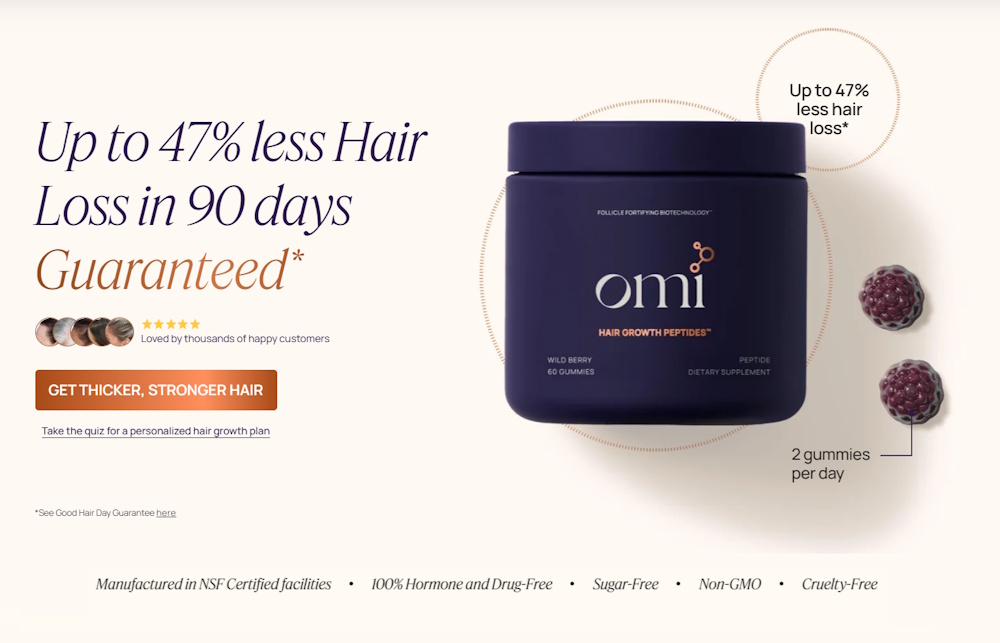
OMI Wellbeauty is a Hair Growth Peptide brand that launched in early 2025. Its first year ran on earned media, not paid. Beauty editors adopted it early, and Vogue named it a best beauty product of the year. The brand grew quickly off that coverage. It did not build the operations to scale.
Entering 2026, the mandate was to turn cultural traction into a business that grows predictably across D2C and Amazon.
The timing made that urgent. Peptides had become one of the few ingredients that dermatologists, editors, and consumers all agree on. Hair care was shifting toward the scalp as the source of hair health.
Where the business was
When Kynship first met OMI, QVC carried roughly 30% of total revenue and pulled the overall business close to break-even. The direct business lost money on its own.
OMI had spent nearly half its revenue on ads over the previous year. Topline revenue was starting to scale. Efficiency had deteriorated to get there, and CAC was climbing out of control.
OMI's biggest asset was retention, with a repeat rate 25% above Kynship's benchmark.
That meant OMI could afford to pay more for a new customer than it realized. Kynship used its P&L audit to show stakeholders targets that would let the brand scale both efficiently and aggressively.
What the team was focused on
In 2025 the brand was in a gilded cage. Efficiency was strong, but only up to about $7k a day in spend. Above that, returns fell away, so the account looked healthy and the business couldn’t grow. The goal for the year was to break that ceiling and scale spend without giving up the efficiency the account was built on.
The disagreement was about how far and how fast. The CFO model assumed ad spend could grow to more than four times the prior year with blended efficiency holding at 1.0.
Kynship’s position was that this couldn’t work. Efficiency doesn’t hold flat while spend multiplies. Every extra dollar competes for customers that better-funded competitors with stronger retention are also bidding on. The plan had to earn the growth in spend rather than assume it.
Kynship modeled 2.2x spend delivering 2.3x revenue, so revenue kept pace with spend instead of falling behind it. OMI’s own leadership had independently reached the same case, and that settled the internal debate.
The forecast conversation mattered more than the media plan. Before any creative shipped, the engagement started by agreeing how much spend the business could take on efficiently, and what had to be true to get there.
What the audit found in the account
Kynship treats P&L audits and financial forecasting as the foundation of the work. That discipline is what lets us grow clients aggressively without breaking them.
Here's what the audit of OMI's ad account found.
- Creative volume was too low for the spend, and the library was being pruned by hand. Ads were manually turned off about six times a month, and fourteen times a month on the highest-spending campaign. Every one of those actions resets optimization.
- Two bid strategies were competing in the same auction. Highest-volume and cost-per-result campaigns ran at the same time against the same inventory. The guaranteed-spend campaigns won first position, and the cost-controlled campaigns got what was left. The cost-controlled campaigns looked like they were failing. They were being starved.
- Daily budgets were capping delivery. The highest-spending campaign hit its full daily budget the day before the audit. When the budget is the constraint instead of the bid, the algorithm can't spend into demand it has already found.
- Ad sets were split by persona. Menopause creative sat in one ad set and stress creative in another, all driving to the same product page. That fragments signal across ad sets instead of letting Meta match creative to person inside one pool.
- Spend was reaching existing customers. In February, a meaningful share of spend went to audiences made up of current or past customers. With a repeat rate that strong, OMI had no reason to pay to acquire them twice.
- Branded search was contaminating non-brand data. Branded terms bled into non-brand campaigns. That inflated non-brand performance and made scaling decisions unreliable. Imported customer lists were never applied to campaign- or account-level bidding.
Each of these problems is structural and fixable. Together they meant the account couldn't tell the team what was working. That is why scaling spend had cost efficiency instead of compounding it.
Kynship also graded the account's creative diversity at takeover. The balance of video and static was healthy. The account was under-indexed on product-forward content.
How Kynship Enabled Efficient Growth
Here's what Kynship did to more than double OMI's new customer revenue in four months while improving efficiency.
1. Implemented cost controls derived from P&L
None of the creative volume is safe without a financial guardrail underneath it, so the guardrail came first.
Kynship runs every account on cost controls. Each ad carries a bid ceiling tied to what OMI can afford to pay for a customer. The bid governs spend, not the budget. That resolved two audit findings at once:
- Kynship consolidated the two competing bid strategies onto one.
- Budgets were set deliberately high, so the daily cap is never what stops a good day.
The bid level came out of the retention work. With a higher than average repeat rate, OMI could afford customers that first-order math called too expensive. A brand with strong retention that bids like a brand without it loses every auction that matters.
Cost controls also change what testing costs. On a budget-based structure, launching hundreds of ads spreads spend across hundreds of ads, and you pay to discover the few that work. Under cost controls, ads that can't deliver at target stop spending on their own, and ads that can deliver absorb more. Volume stops being a risk and becomes one of the biggest goals.
But volume without diversity is redundancy at scale.
Most brands think they are diversifying when they are iterating. They take the best-performing static and swap the color. They take the best testimonial and swap the text overlay. Those look like different ads to a person. To Meta they are the same. If roughly 70% of a creative is unchanged, the auction reads it as the same asset, and the account builds up fatigue instead of reach.
Real diversity means a different message, a different style, and multiple formats. The goal is an ad for everybody, both for the person scrolling and inside the auction.
Kynship grades diversity on two axes at takeover:
- Static versus video.
- Product-forward versus human-forward: whether the product or the person is the hero of the shot.
The working benchmark is a roughly even split between product and human, with a slight lean toward video. That grade is a diagnostic, not a target. It runs once, shows where the easy wins are, and is then retired. Forcing an account toward a benchmark split would contradict the approach, which is to let spend decide direction.
Supplying diversity at volume takes more than one source. Kynship ran influencer seeding for OMI. Each month we gifted product to new micro-influencers with no strings attached and no script, then secured usage rights to what they made. Having no brief is deliberate. Detailed parameters produce fifty versions of the same video. Open-ended gifting produces unboxings, tutorials, testimonials, and formats nobody would have thought to specify.
2. Increased longterm publishing frequencly.
Kynship worked with OMI's in-house creative engine to begin shipping new creative into the account every one to two weeks from launch onward.
Tactically, the account never runs out of fresh creative to test against ads that are fatiguing. By the time an April ad shows frequency fatigue, June's batch is already live.
Strategically, continuous testing means there is always enough signal to make a budget decision. The team doesn't wait on a quarterly refresh to explain what happened.
3. Doubled ads receiving $1k+ spend at target efficiency
Kynship helped OMI nearly triple active ads in the first month, jumping from 208 to 537, and held the pool there through the summer. Four months later OMI had nearly twice as many ads earning real budget.
Under cost controls, Meta is in charge of managing budget on each ad, and spend only increases on ads that are hitting the efficiency target. That means that a key metric in scaling growth is increasing the number of ads recieving significant ad spend. The greater volume and dviersity, the btetter.
Kynship and OMI managed to nearly double ads receiving $1,000 spend per month, going form 35 to 63 in just 4 months. That means OMI's budget is now diversified across nearly twice as many validated acquisition vehicles, a huge win for the account and major driver in the 2.4x revenue growth over that period.
4. Helped OMI revamp landing pages
New creative only pays off if the traffic converts once it lands. Alongside the creative work, Kynship recommended that OMI build new landing page infrastructure.
OMI's team executed. In May they launched several new pages and a dynamic, quiz-based funnel.
Within months of launch, the quiz funnel had become the fifth-largest destination for paid traffic, with a ROAS near the top of the range.
Under cost controls, that allocation isn't a media plan decision. Meta routes traffic to wherever it can acquire customers at target, and it moved a meaningful share of traffic onto pages that didn't exist before May.
The Results
Here's what we were able to accomplish in just four months:
- New customer revenue grew 144% in four months, faster than the spend behind it.
- Efficiency improved while spend scaled. aMER increased by 10% while doubling spend.
- Ad spend grew 121%, reaching OMI's monthly spend goal for the year in just four months.
- Ads spending $1k+ nearly doubled as a result of tripling active ads
Spend peaked in July and eased off in August. New customer revenue kept climbing. That gap is where the profit came from.
Forecast versus actual
The spend plan landed almost exactly as modeled, and the account reached the year's monthly spend goal in four months.
Efficiency beat the forecast. The CFO plan assumed a moderate baseline blended efficiency. Kynship set the target at a 25% lift, and the account achieved a 31% lift in August.
The Bottom Line
OMI more than doubled monthly new customer revenue in four months. Efficiency improved while it did, and the business went from unprofitable to profitable seven months ahead of plan.
The growth came from three things:
- ad targets set from the P&L
- a creative pipeline built for volume and diversity, running under cost controls
- a landing page overhaul that gave paid traffic somewhere better to go
DTC growth doesn't start in the ad account. It starts with the numbers the business can support, and then the media plan is built backward from them.
Kynship helps DTC ecommerce brands between $2M–$100M break through growth plateaus by reverse engineering from both top and bottom line goals, building scalable creative systems, and driving new customer growth profitably. If you’d like help growing your brand efficiently this year, fill out the form below
Why choose The Kynship System?


We use cookies to optimize our website and your experience with Kynship. But, like our democracy, you're in control. View our Privacy Policy for more information.

Privacy is important to us, so you have the option of disabling certain types of storage that may not be necessary for the basic functioning of the website. Blocking categories may impact your experience on the website. More information